 Raucous teens stood around abashedly while chatting among themselves. The smell of Dorito’s and Frito’s permeated the air. DC-based Post-punk singer/guitarist/songster Carol Bui stood center stage alone, and sang a capella a traditional Vietnamese folk song in Vietnamese, under the dim stage light at the Third Floor in Fredericksburg, VA on the night of 2/23/08. (“Gau cao gio bay” appears as the last track of Bui’s critically favored 2007 album Everyone Wore White). In the open gallery hall, Bui’s voice reverberated far and deep as it pierced through the vociferous chattering of the teens. Social interactions ceased suddenly and then everyone proceeded to sit down to witness Bui’s evocation. People and spirits congregated, all anticipating a night of vigor, thrill, and rock and roll. Its ritualistic resonance was astounding and sobering.
Carol Bui’s band joined her after the opening number. She rocked out on her Telecaster the rest of her set. They played songs from Everyone Wore White. With precise and apt distortion, Bui’s guitar spoke and cried with anger. Her guitar playing is Sonic-Youthian and her aesthetic leanings toward noise and ambiguity remind me of the Riot Grrrl sound and PJ Harvey. Bui's voice bled through vulnerably. She sometimes took the liberty to let her vibrato quiver and sometimes sail into a sonic abyss. Her voice trembled, but never faltered. Strength prevailed in every enunciation.
The harmonic complexity – with a plenitude of minor chords, modal intervals, and dissonance – in Bui's music projects a sense of tonal ambivalence. Her anchorless music rustles in the mind and engenders a vivid context for emotional density. In this musical world, the dichotomy between tension and resolution doesn’t exist. No gravitation, only snippets of stasis. Existential angst is nothing new in the post-grunge age. But Bui’s astute emotional detailing is remarkable. Her songs touch on subjects such as faith, mother-daughter relationship, broken heart, adolescence, places, and the interconnection between these parts of life.
I love Carol Bui’s songs. Bui’s self-consciousness means to me an audacity to confront life’s difficulties. It is power amidst chaos, confusion, and change. I’m not sure if the teens at the Fredericksburg All Ages show felt that about Bui’s set. Maybe it takes a slightly more aged soul to appreciate Bui.
More images of Carol Bui's show.
3.05.2008
Carol Bui: Power Amidst Chaos, Confusion, and Change

2.29.2008
Kazu Makino of Blonde Redhead sings a Yoko Ono song
Kazu Makino has reinterpreted and recorded a Yoko Ono song. Makino' s performance of “Listen, the Snow is Falling” (first released as a single by Ono in 1972) now in two parts opens and closes Recitement. The compilation album contains tracks that are half-spoken-word and half-music arranged and released by composer/musician Stephen Emmer from Amsterdam, Netherlands. Recitement can be previewed on the Recitement website.
The process of Recitement's production is unconventional: First text, then music. Singers, actors, and poets, such as Lou Reed and Allen Ginsburg, reinterpreted and performed “modern and classic” spoken word texts. Then Emmer composed music around the vocal performance. I read that Yoko Ono herself was pleased with Makino’s interpretation of Ono’s text.
Kazu Makino is known for her incredibly rich vocal palette in the no-wave-influenced (many people compare them to Sonic Youth) indie pop band Blonde Redhead based out of New York. One of my favorite tracks featuring Makino’s bleak visceral vocality is “I Still Get Rocks Off” from La Mia Vita Violenta” (1995). Her arty screams, moans, and cry-breaks sprinkle the track in unexpected ways and places. Makino rips her voice (or her throat!) with generosity, and with pain. Both In An Expression of the Inexpressible (1998) and “La Mia Vita Violenta” are blessed with an abundance of Makino’s noisy vocal gymnastics. Makino's style reminds me of Yoko Ono’s early vocalization, mostly during the Plastic Ono Band period (circa 1968-1972).
Makino’s tracks on Recitement sound promising from my preview of them. I will write about my reflection of them once I get a close listening of them. For now, I’m just excited to spread the word about this recording. Personally, I’m psyched about this Ono-Makino connection, which I always sensed in their music.
Here's a picture of Kazu Makino at Blonde Redhead's show last August (2007) at Rams Head in Baltimore taken by my photographer friend Chia Chi Chang:
2.24.2008
Each Others Mothers rocked out with lovers at the Black Cat
I saw Each Others Mothers again at the Black Cat on 2/14/08 (Valentine's Day!!). They rocked the venue and blessed the lovers and valentines with their high-energy outpour of exuberant math indie punk. Plenty of notes, love, and fun! Their new tunes are sweet!!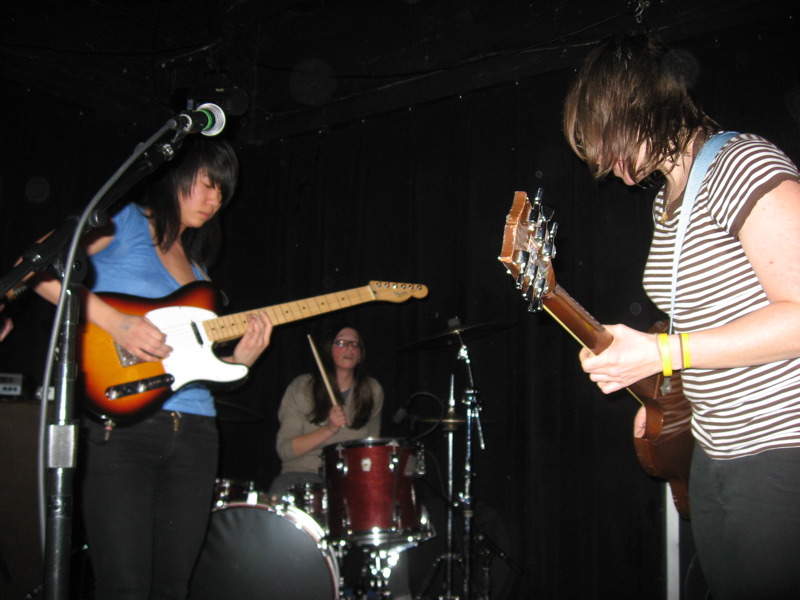
@ the Black Cat, DC
Each Other's Mothers @ Rumors in Richmond on 11/17/07.
More pictures of Each Other's Mothers.
Magazine Interview about Asian Pacific American (APA) Music
I recently participated in an interview conducted by Inkstone, a UVa-based, student-run magazine devoted to Asian Pacific American (APA) literary arts and culture. The coming issue will feature a few UVa scholars (faculty and graduate student) who research APA arts. The issue will be released in late Spring this year. Below are contents most relevant to Yellow Buzz:
// What is Asian-Pacific-American music the way you understand it? //
Oh gees. This sounds like one of the questions on my comprehensive exams! APA music has yet to be canonized, although a number of academics and record labels have attempted to do so. For instance, Itchy Korean Recordings, based out of Houston, TX, released a compilation titled Wok and Roll featuring 14 multiethnic or Asian American punk and hardcore rock bands. Similarly, New York-based label Born in Chinese put out a compilation titled CompilAsian: A Collection of Asian American music, featuring 12 Asian American recording artists and groups of rock, pop, soul, and R&B. These recordings, in part, seek to shatter the silence or invisibility of Asian American representation in mainstream media. Also, MTVchi, an offshoot of the MTV network that broadcast program featuring Chinese American and other Asian American artists and VJ’s in order to cater to and create an Asian American audience, is another example of an institutional attempt to define APA music. This network, however, went off-air in 2005.
In many ways, I think, we’re still struggling with the baggage that otherizes Asian (or Orientalizes) culture inherited from the historical structures of the U.S. music industry. Specifically, the oppressive black-and-white racial binary still to this day informs our commonsensical understanding of commercial musical genres. There are white music genres such as country (historically known as “hillbilly” records) and rock. And there are music categories associated with African American performers and listeners, for example, hip hop and R&B, or the historical genre of “race records.” The racial binary that governs music genre division leaves a conundrum or a dilemma with which Asian American musicians grapple in their everyday struggle to express themselves authentically through the idiom of music.
Contrasting the general lack of APA musical representation is the active presence of Asian American musical production (consumption) at the grass-roots level. The current musical heterogeneity in Asian America resonates with the social diversity of the community. This makes it difficult to derive any generalities about the sound or content of this music. I personally resist the notion of APA music because it has not had a prominent existence in practice. What’s undeniable is the presence of APA musicians, professional, amateur, performing in all musical genres. Part of my academic (and musical) effort is to conjure (however) truthful images and narratives about the lives – and music – of these below-visibility APA musicians. For now, my working definition of APA music is the music made and listened to by individuals of Asian descent in the U.S. The broadness of this definition marks the yet exploratory state of this research.
// What does a reader/listener of APA music have to look forward to? //
Some of the most interesting music in Asian America emerges from the creative ways in which musicians have played with genre conventions. Anime punk (rock) is an example of this. Anime punk is the general subculture of anime in North America. Anime punk bands, mostly based out of New York, LA, and Tokyo, make frequent appearances at anime conventions in the United States.. Many of these bands perform in “character” in ways to resonate existing characters in familiar works of anime or more abstractly, to represent the general aesthetics of anime fashion and imagery. Peelander-Z, a self-identified “Japanese Action Comic Punk” band from Brooklyn, usually dress up in costumes and combine the raw sounds of punk and the interactive techniques from Japanese (as well as Korean and Taiwanese) game shows in performance. Their interactivity with the audience is astounding. I went to their show in Richmond last November and had a blast banging on pots and pans and watching them do “human bowling” offstage. By the way, they are coming to Charlottesville on March 5.
There are many other APA musicians who are doing innovative genre-bending. Carol Bui from DC blends in elements of Vietnamese pop singer Khanh Ly’s vocal style in her Sonic-Youth-and-Riot-Grrrl-inspired post-punk songs. And on her new album Everyone Wore White, Carol covers a traditional Vietnamese folk song a capella. Also, indie experimental rock band Kite Operations, led by Korean American Joseph Kim, just recently covered a Korean pop song in a free-jazz, late-Coltrane style. And, the Korean members of the feminist art rock band Taigaa! from Brooklyn cite “bbong jjak”, a pre-80s style of Korean pop music, as one of their main influences.
Musicians sometimes use conventionally Asian instruments in the context of American pop or rock music. For example, Jack Hsu of the Hsu-Nami fronts a New Jersey-based hard rock band playing amplified erhu, a traditional Chinese 2-string bowed instrument. Jack plays the erhu standing up with it clipped to his waist. He even shreds on his erhu! His main influences include Steve Vai and Slash of Guns N’ Roses.
There are many musicians who consciously derive musical inspirations from contemporary popular music genres in Asia such as JPOP, CPOP (MandoPOP, CantoPOP, and TPOP) and KPOP. Of course, there are many musicians of other genres that are transgressing ethnic/national boundaries. Yo Yo Ma’s Silk Road Project example is a well-known classical music example. Generally speaking, many of these musical links between US and Asia lead to or are products of actual transnational social connections between APA musicians and their Asian peers. This is especially made possible when APA musicians tour in Asia or when Asian groups tour in the U.S. This kind of transpacific social and musical connection – particularly the grassroots ones – is totally exciting to me.
// What will a reader/listener of APA music be disappointed with? //
I think the general lack of visibility of Asian Americans in music is disappointing. Hardly ever we see an Asian American person on mainstream TV network or on the cover of Rolling Stone, Spin or Vibe. There have been, of course, a few iconic Asian/Asian American figures in the U.S. cultural landscape: James Iha of Smashing Pumpkins, Joseph Hahn and Mike Shinoda in Linkin Park, Tony Kanal of No Doubt, Joey Santiago of the Pixies, Allen Pineda in Black Eyed Peas, Karen O of the Yeah Yeah Yeah’s, Lyrics Born, etc.
One thing that I find quite disappointing is there is much Asian American internal solidarity in music. While there are hip hop groups comprised of all Asian American members, such as the Mountain Brothers, most Asian American musicians perform and collaborate with white American musicians. So far I’ve only encountered a few bands composed of all Asian American members. I would like to see more of that.
// Describe the great and not-so-great moments of APA music history. //
One great moment in APA music history has to be Yoko Ono’s 2007 album release of Yes, I’m a Witch. Ono has unfortunately bore the onus for breaking up the Beatles for the last 35 years (which by the way was constructed mostly by media rumors and gossips). The vast and stimulating works of art and music has yet to be received much positive attention. This 2007 release consists of recordings of Ono’s music re-rendered and re-produced by leading indie rock, hip hop, and electronica figures including Cat Power, DJ Spooky, Le Tigre, Peaches, Flaming Lips, Antony (of Antony and The Johnsons), and many more. This album introduced Ono’s ahead-of-her-time songwriting skills and vocal style to a wide audience. And it has inspired listeners and critics to take Ono’s music and art seriously, possibly for the first time in history.
The appearance of William Hung on American Idol and subsequently in media marked a peculiar moment in APA music history. On the one hand, his performance yielded an array of responses. Some people uncritically embraced him for comic relief or commended him for being “clever” and achieving instant fame. Others vehemently censured his image and accused him of reinscribing the stereotype of the “Asian gook.” There were of course individuals who took his image literally thus perpetuating the Asian model minority myth. This was a very awkward moment for me. I felt like on the one hand, I had to come forward to assert my opinions about the William Hung “phenomenon”. On the other hand, I was intellectually curious about the complex construction and reception of his stardom. Politically, I would say, it was a not-so-great moment for Asian American representation in music.
Other than that, there are quite a few moments that scholars have discussed: the musical Flower Drum Song, with a mostly Asian cast, depicts the bicultural social life of Chinatown in San Francisco on Broadway and big screen first time in history; the Grain of Sand’s political folk songs that led and reflected the spirit of the Asian American identity politics movement in the early 1970s; and the Chinese American rapper Jin’s winning of “Freestyle Friday” on BET and his subsequent record deal with Ruff Ryders.
The final version of the interview will be posted on Yellow Buzz once the issue is released in late spring.
2.12.2008
Thao with the Get Down Stay Down: Swinging & Rocking Charlottesville
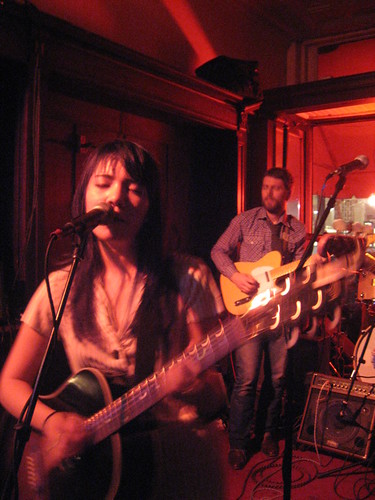 I’ve become a junkie to Thao Nguyen’s music. Her voice mystifies me. Her whimsical words swivel in fragments and her catchy tune freshen my earlier memories of sounds, warbles, and musical pleasures. Thao rocked the house with her DC-based band the Get Down Stay Down last Saturday night 2/9/08 at Miller’s. For a few hours that night, Thao and her band let in a little bit of air to freshen the Dave-Matthews-looming southern acoustic/jam rock cultural landscape of Charlottesville.
Thao led the band by playing an acoustic Gibson. Sometimes picking, other times strumming and striking the strings with a toothbrush, Thao played guitar while creating uneven sonic fabric upon which her vocals danced. She sang and played syncopated rhythmic patterns with precision, balanced by an appropriate level of spontaneity. Between songs, Thao and the band passed around a tiny bottle of Crown Oil. Slightly intoxicatedly, Thao's vocal cords relaxed and she graced us with soft yodeling: a break between vocal registers. What I heard was a unusual vocal timbre reminiscent of Bjork’s viscerality, David Gray’s vulnerable grittiness, and Norah Jones’ contempo-twang.
Thao and the Get Down Stay Down played songs from their new CD – We Braved Bee Stings and All – released by Kill Rock Stars a little more than a week prior to the show. A number of men and women in the audience knew the lyrics and sang along verbatim. Pleasures to the ear and the body (i.e., foot tapping, clapping, nodding, and finger dancing) permeated the bar and sneaked through the neon lights hung on the window to the brick pedestrian walkway of the Charlottesville Historic Downtown Mall.
Thao obscures her diction when she sings. But I’m not sure if diction and verbal contents are what matter the most in her music. Thao’s incredibly rich vocal palette is convincing. There’s no melodrama, literalism, or showiness. Her persistence of abstract playfulness is unforgetable. If I had to put my attraction to Thao's music in words, it’s her aesthetic leaning for fragmentation rather than holism, ambiguity over clarity, and an ironic yet ambivalent stance regarding the mundane. Whatever it is, she delivers it with plenty amicableness and artfulness. I imagine - many of us of the post-civil-rights generation resonate with Thao's self-conscious pleasures in our postmodern orientation in life. Rock on, Thao!
More images of the show.
1.21.2008
A Note of Confession from a Connectionist: Reflecting on Kite Operations
 I promised myself that I would write a reflection about one of my favorite songs discovered in 2007 – “Tracing Paths", a track off of Kite Operations’ 2005 album Dandelion Day (K.O.A. Records). Kite Operations is a self-label indie/experimental/freestyle rock band based out of New York City. The band is made up of former members of Sonic-Youth-inspired noise rock band Theselah. I came upon this song fortuitously through web browsing. I’ve been in love in with this song ever since I first clicked on it on their MySpace. Since their tour in Korea in fall 2007, the band has been working to establish a commendable transpacific link by introducing their favorite Korean indie rock bands to the U.S. via their associated web-released zine.
Lyrical poetics is a little hard to come by these days. The words of “Tracing Paths” remind me of songs on Joni Mitchell’s Blue - with concrete details from everyday life interwoven with abstract message about life, or cosmos. There are motions, emotions, and commotions made up of the two in fragments. I’m a sucker for pragmatist profundity, perhaps a symptom related to the Gen-X lethargy, coming from the slackers who are just now waking up to discover that the world has proceeded beyond the culture of nihilism and guilty pleasures looming in the last decade. “we trace our paths like cursive, chasing a life of soft pleasures. the moment you leave, another one takes over.” We (whoever we are) take pleasure, rather self-consciously, in the form of circularity, the dead-end logical state of tautology.
“we came as one, but i leave alone. i take my food from the fed, clothes from the dressed, love from the loved.”
With 6/8 meter, the repeated ascending guitar riff and vocal line stir up mini ripples while the upright bass and drums provide a rhythmic anchor. “throw them together and witness the splatter. the worlds collide.” Following the breaks in the lyrics, musical cadence gently lets in a pool of noisy chaos. With a kind of Krautrock CAN-ish rhythmic disciplining, distorted guitar, feedback, and cymbal crashes, not at all contrived, exert timbral pressure and sprinkle with teleological forwardness. In these cathartic sequences, I always listen for the “unexpected” placement at which the last bomb is dropped hoping to be surprised by it – again and again.
“the moment you leave, another one takes over.”
Am I a relativist? Maybe, aesthetically. What I enjoy is connection, the grey area, dialecticism, the Middle way. Feelings of disconnection or the binary, either/or logic often alienate me (although alienation is the overcast sky under which we find comfort among friends). If there were one affect that I fall, fight, scream, and contend for, it would be that of connectedness.
“Tracing Paths” is submerged in circles, curves, cursive, and waves. No verses, no chorus. No tonic, no dominant. The end is the beginning. The beginning is the end. The ebbs and flows still resonate even after the CD stops spinning. Maybe this song has the potential to propagate a sense or even an ethos of connectionism in our world.
12.08.2007
Yellow Buzz news!
Yellow Buzz is excited to announce some exciting news:
1. The article on Yoko Ono's Imagine Peace Tower and her various activist art projects, recently published in RVA magazine, is recognized and posted on Ono's official website. : )
2. RVA magazine offered to synchronize Yellow Buzz with its web hub. I will post the details later.
Thanks for reading and supporting, everyone!
12.03.2007
Melt Banana Blasts with Metrical Blasphemy
Melt Banana creates the ultimate form of music that keeps people on their feet and toes. A musical sleight of hand. Or a metrical blasphemy. Rhythmic and formal elements are constantly shifting. Jagged patterns of phrasing sound unexpectedly alternating between singing and screaming, jerked by tugging motion between vocals and guitar. I witnessed the Tokyo-based Japanese noise rock band at Satellite Ballroom on the University Corner, across the street from Thomas Jefferson’s historic university in Charlottesville, VA on 11/15/07. It was another unusually chilly night for November in central Virginia. The number of local Melt Banana lovers I expected turned out to be kind of meager, though quality of love exceeded its quantity. Bundled up with wintry apparel (and intense facial hair for some), dancing and nodding, the audience had a blast being pushed and pulled by Melt Banana's 8-settings-all-at-once rhythmic blender.
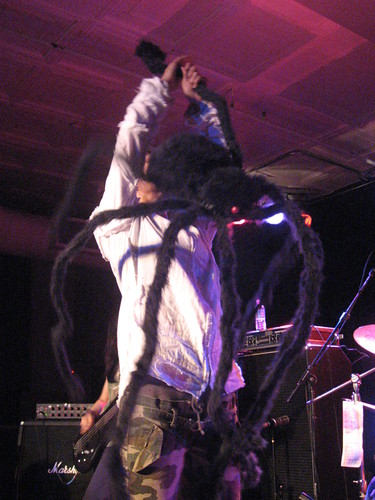
The Richmond-based Hex Machine opened for Melt Banana. Their set was dark, droney, and indeed heavy and rhythmically refreshing. Onuki Yasuko, the vocalist of Melt Banana, came onto stage with a stiff black spider stuffed animal. She positioned it on top of the left PA speaker. This didn’t seem puzzling to the audience. With no hesitance, the band plunged into an abyss of well-defined sonic chaos.
Short, fast tunes burst with sparkles and flames. Melt Banana bestowed upon audience with two hours of loving straight-ahead “Spas-Core.” The off-kilter vigor emanated from Yasuko’s noise-core screaming and Agata Ichirou’s virtuosic pedal stomping generated a well of euphoric intensity in the atmosphere. Each time Ichirou “talked” with his SG through his whammy pedal, I promised to myself to study his technique with a closer look. My attempt, unfortunately, didn’t yield much technical knowledge except for a few exciting snapshots of him in action. Ichirou’s impeccable sense of timing enlivened the whammy sound while turning it into a lo-fi sonic figure out of an 8-bit arcade machine. Drummer Uki Eiji and bassist Rika mm’, with her seriously head-banging-and-whirling, held the grounds by not simply providing the beat, but layering complex web-like rhythmic textures.
Chatting with my friend Scott of Hex Machine, I learned that all the members of Melt Banana were trying to outdo themselves from the previous night in Baltimore. Having seen one of the most exhilarating shows of the year, we went home and slept on remnants of ear treats.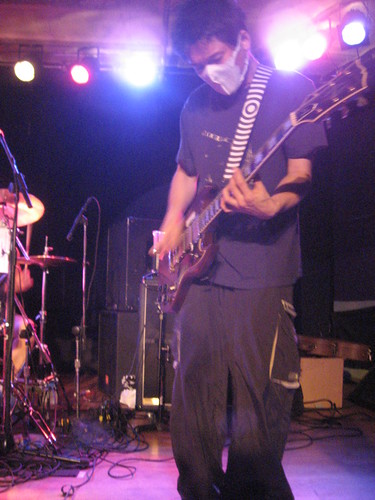

more pictures
11.30.2007
Article on Yoko Ono's Art Activism
My article "Yoko Ono Imagines Peace with the World" came out in the November issue of RVA magazine. The editor of the magazine wrote Ono and obtained from her some beautiful high-resolution images of the Imagine Peace Tower directly. Here's the link to download the original article in a pdf file. [The article is on pages 60, 61, 62, and 63].
Enjoy and let me know what you think!
11.16.2007
The Magical Efficacy of Peelander-Z
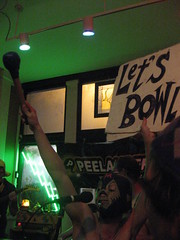 Peelander-Z stormed in with their infectious fun-driven insanity at the Camel in Richmond, Virginia on November 7, 2007. Self-labeled as “Japanese action comic punk,” the New-York-based trio invigorated the socially sleepy downtown Richmond only a few blocks away from the iconic confederate hero Robert E Lee statue, one of the most visible structures in the city. Richmond’s cultural landscape may not be as dormant, regressive or even washed out as it seems above-ground. The presence of an anime punk band, to a large degree, resonates with the backdrop of Richmond as an East Coast hub of punk and hardcore that gave birth to GWAR. The aesthetic genealogy of Peelander-Z, to my knowledge, must have crossed that of GWAR somewhere along their outrageous ride of high-energy, raw sound and dramatic characterization.
“We are not American! We are not Japanese! We’re not even human! We are Peelander-Z!!!!” [All vocal gestures by Peelander-Z reverberated with exclamations.] Proclaiming to be of an anime-derived outer-space species, Peelander-Z wore power-ranger-like polyester suites and played through a series of tune-driven segments interwoven with interactive routines such as audience call and response and human bowling. Peelander-Z demonstrated the “claw” and the audience responded with their “claw” back during opening tune “Mad Tiger.” Peelander-Red then dragged out a suitcase full of pots, pans, and drumsticks while inviting the audience members to join the band by making percussive sounds. Human Bowling, as one would imagine, was one Peelander member bowling his band member across the hall and into a set of bowling pins. Throughout the set, the drummer held up signs to cue the audience into responding with particular phrases, gestures or actions.
The audience, comprised of mostly 20-or-30-something White Americans with punk-inflected apparel (tapered jeans and canvas Vans), got wild, dirty, and down with Peelander-Z. The women especially went nuts during the interactive breakdown sessions. I saw three girls in their early teens with their fathers, who had on autographed Peelander-Z Tshirts. Even the audience members most unfamiliar with the band felt connected to be participants.
Peelander-Z’s interactive techniques demonstrate an impeccable and unexpected synthesis between elements from punk, anime, and Japanese/Asian game shows (popular in East Asia. The premise of these show is for audience to interact with celebrity icons). There is something mysterious and almost ritualistic about Peelander-Z’s live shows. I shed all my skepticism and inhibition after their “Mad Tiger Claw” warmup. Their power of conjuring up immediacy, liveness, and interactivity is shamanistic – perhaps more efficacious than the folk evocation of personal sincerity and social intimacy.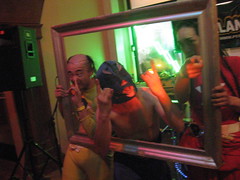
How about a Kodak moment with Peelander-Z? [more images]




